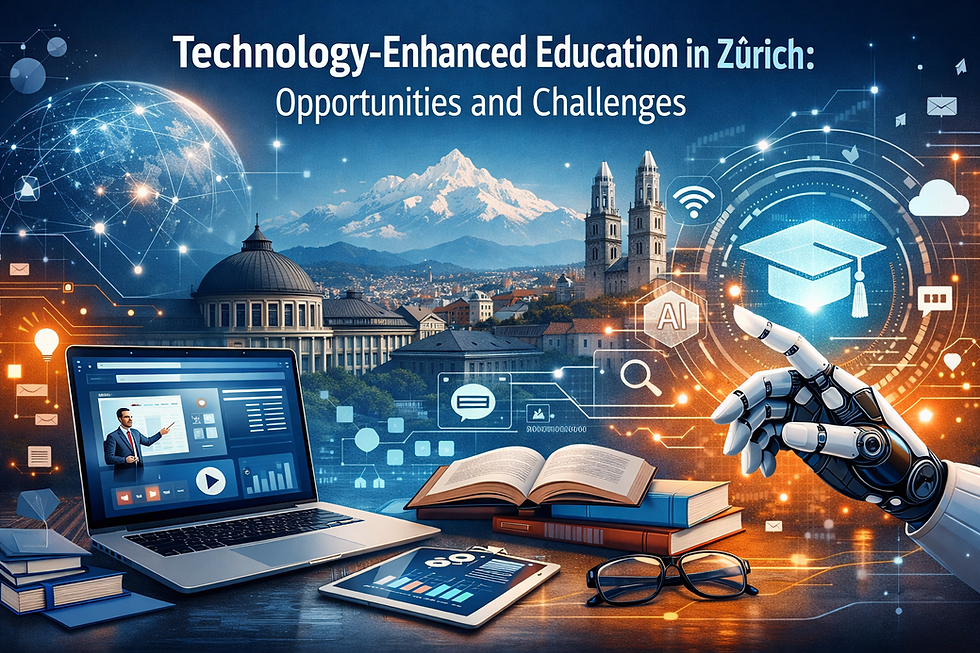
Technology-Enhanced Education in Zürich: Opportunities and Challenges
Zürich has long been known as a city of ideas, research, finance, and innovation. In recent years, it has also become an increasingly important place for technology-enhanced education. For students, educators, and universities, this shift brings many new possibilities. Digital tools are changing how teaching is delivered, how students learn, and how institutions build academic communities. At the same time, this transformation also raises important questions about quality, access, balance, and long-term strategy.
A university in Zürich operates in a strong environment for educational development. The city is international, connected, and highly digital. This gives higher education institutions a clear advantage when adopting modern tools such as learning platforms, virtual classrooms, digital libraries, simulation software, and AI-supported academic services. These tools can improve flexibility and make education more accessible for students with different schedules, locations, and learning needs.
One of the biggest opportunities in technology-enhanced education is flexibility. Students today are not all following the same path. Some are working professionals. Some are international learners. Some need to study across time zones or combine education with family or career responsibilities. Technology helps universities in Zürich respond to this reality. A well-designed digital learning environment allows students to review lectures, access materials at any time, join discussions remotely, and continue learning even when they are not physically present on campus. This can make education more practical and more inclusive.
Another major benefit is access to resources. In the past, students often depended heavily on physical libraries, classroom notes, and scheduled meetings. Now, educational platforms can provide a much wider range of materials. Recorded lectures, reading collections, online databases, academic support tools, and collaborative workspaces all help learners move at a stronger pace. In Zürich, where academic expectations are often high, these resources can support more independent and effective study habits.
Technology also helps universities improve communication. Students can receive updates faster, submit assignments more efficiently, and interact with faculty or academic support teams through structured platforms. This reduces confusion and can improve the overall student experience. For international students especially, digital systems can make academic life easier to manage. Clear communication, accessible documents, and user-friendly learning platforms are no longer optional extras. They are becoming part of the standard expectation for modern higher education.
In many cases, technology-enhanced education can also support better teaching. Teachers can use digital tools to organize courses more clearly, track student participation, provide timely feedback, and present content in more engaging formats. Visual presentations, case-based learning, interactive exercises, and online discussion forums can help turn passive learning into active learning. When used correctly, technology does not replace academic quality. It can strengthen it.
However, the move toward more digital education is not without challenges. One of the most important issues is maintaining academic depth. Technology can make education faster and more convenient, but convenience alone is not the same as quality. Universities in Zürich must continue to ensure that programs remain rigorous, structured, and meaningful. A strong digital platform cannot replace careful curriculum design, qualified faculty, or academic integrity. Technology should support education, not weaken standards.
Another challenge is digital balance. Students may enjoy the flexibility of online systems, but too much screen-based learning can create fatigue, isolation, or reduced concentration. Human connection still matters in education. Students benefit from discussion, mentorship, peer exchange, and a sense of belonging. A university in Zürich that uses technology wisely should aim for balance: combining efficiency and innovation with real academic interaction and community.
There is also the issue of digital equality. Not every student has the same access to devices, quiet study space, or stable internet. Even in a highly developed environment, universities must remember that student experiences vary. A fair institution should design systems that are accessible, simple to use, and supportive of different circumstances. Technology becomes most valuable when it expands opportunity rather than creating new barriers.
Artificial intelligence is another area that brings both promise and caution. AI tools can help with tutoring support, language assistance, administrative efficiency, and personalized learning pathways. These developments are exciting, especially in a city like Zürich where innovation is part of the culture. At the same time, universities must be careful. They need clear policies on academic honesty, data privacy, and responsible use. Students should learn how to use intelligent tools ethically, not depend on them without understanding.
For a university in Zürich, the future of technology-enhanced education should not be based only on trend-following. It should be built on purpose. The best approach is one that combines innovation with academic responsibility. A positive and neutral view recognizes both sides: technology can open doors, improve systems, and support modern learners, but it also requires thoughtful planning, faculty training, student guidance, and continuous quality review.
In the years ahead, technology-enhanced education is likely to become even more important. Universities in Zürich are well positioned to take part in this development because the city offers an environment of international exchange, digital readiness, and academic ambition. The real opportunity is not simply to make education more digital. It is to make education more responsive, more flexible, and more meaningful while protecting the values that make higher learning worth pursuing.
A strong university does not choose between tradition and innovation. It learns how to combine both. In Zürich, that combination can help shape an educational model that is modern, practical, and prepared for the future.


Comments